| OIV |
description |
value |
images |
| 001 |
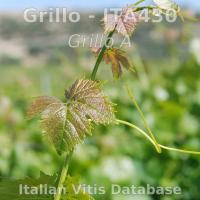
Young shoot: opening of the shoot tip |
5
|
fully open
|
|
| 002 |
Young Shoot: distribution of anthocyanin coloration on prostrate hairs of tip |
3
|
overall
|
| 003 |
Young Shoot: intensity of anthocyanin coloration on prostrate hairs of tip |
3
|
low
|
| 006 |
Shoot: attitude (before tying) |
1
|
erect
|
| 007 |
Shoot: color of dorsal side of internodes |
2
|
green and red
|
| 008 |
Shoot: color of ventral side of internodes |
1
|
green
|
| 016 |
Shoot: number of consecutive tendrils |
1
|
2 or less
|
| 051 |
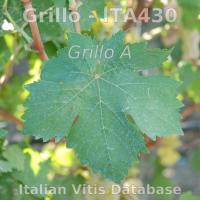
Young leaf: color of the upper side of blade (4 th leaf) |
4
|
copper - reddish
|
|
| 053 |
Young leaf: density of prostrate hairs between main veins on lower side of blade (4th leaf) |
7
|
high
|
| 065 |
Mature leaf: size of blade |
5
/ 7
|
medium
/ large
|
| 067 |
Mature leaf: shape of blade |
4
(
3)
|
circular
|
| 068 |
Mature leaf: number of lobes |
3
/ 4
|
five
/ seven
|
| 070 |
Mature leaf: area of anthocyanin coloration of main veins on upper side of blade |
1
(
3)
|
absent
|
| 072 |
Mature leaf: goffering of blade |
5
(
7)
|
medium
|
| 074 |
Mature leaf: profile of blade in cross section |
2
|
V-shaped
|
| 075 |
Mature leaf: blistering of upper side of blade |
5
|
medium
|
| 076 |
Mature leaf: shape of teeth |
2
/ 3
|
both sides straight
/ both sides convex
|
| 079 |
Mature leaf: degree of opening / overlapping of petiole sinus |
7
(
5)
|
overlapped
|
| 080 |
Mature leaf: shape of base of petiole sinus |
3
/ 1
|
V-shaped
/ U-shaped
|
| 081-1 |
Mature leaf: teeth in the petiole sinus |
1
|
none
|
| 081-2 |
Mature leaf: petiole sinus base limited by veins |
1
|
not limited
|
| 083-1 |
Mature leaf: shape of base of upper lateral sinuses |
1
|
U-shaped
|
| 083-2 |
Mature leaf: teeth in the upper lateral sinuses |
1
|
none
|
| 084 |
Mature leaf: density of prostrate hairs between the main veins on lower side of blade |
1
|
none or very low
|
| 086 |
Mature leaf: density of prostrate hairs on main veins on lower side of blade |
3
/ 5
|
low
/ medium
|
| 087 |
Mature leaf: density of erect hairs on main veins on lower side of blade |
1
|
none or very low
|
| 093 |
Mature leaf: length of petiole compared to length of middle vein |
5
|
equal
|
| 094 |
Mature leaf: depth of upper lateral sinuses |
5
/ 7
|
medium
/ deep
|
| 151 |
Flower: sexual organs |
3
|
fully developed stamens and fully developed gynoecium
|
|
| 202 |
Bunch: length (peduncle excluded) |
5
/ 7
|
medium
/ long
|

|
| 204 |
Bunch: density |
5
|
medium
|
| 206 |
Bunch: length of peduncle of primary bunch |
3
|
short
|
| 208 |
Bunch: shape |
1
/ 2
|
cylindrical
/ conical
|
| 209 |
Bunch: number of wings of the primary bunch |
2
|
1 - 2 wings
|
| 220 |
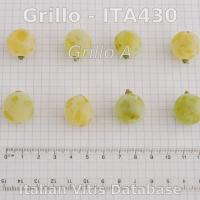
Berry: length |
5
|
medium
|
|
| 221 |
Berry: width |
5
|
medium
|
| 223 |
Berry: shape |
2
/ 3
|
globose
/ broad ellipsoid
|
| 225 |
Berry: color of skin |
1
|
green yellow
|
| 236 |
Berry: particularity of flavor |
1
|
none
|
| 241 |
Berry: formation of seeds |
3
|
complete
|